Highlight

Successful together – our valantic Team.
Meet the people who bring passion and accountability to driving success at valantic.
Get to know usJuly 29, 2025

With the AI Sales Agent, valantic has introduced a powerful AI system for fast, data-driven lead scoring. In the second part of our blog series, you will learn about a proven AI use case with tangible KPIs, how the AI Agent optimizes sales processes, for which fields of application it is predestined and what possibilities the AI system has in store for the near future. Insights and experiences are shared by Christopher Kinnel, Head of Market Engagement at valantic and one of the first fans of the AI Sales Agent.
Introducing: valantic AI Sales Agent
Missed the start? In the first part, find out what’s behind the AI Sales Agent, what challenges it solves and how automated lead qualification works.
What has been your biggest challenge in lead management so far, and how did you approach solving it?
Especially during market engagement activities, which we cannot initially execute in a targeted manner, such as event appearances and trade show visits, it has repeatedly been a challenge to assess, prioritize, and follow up on incoming leads quickly enough. Manual research required significant effort and consumed a lot of time. We wanted to accelerate this research work so we could decide more quickly which next steps offer the greatest added value for each contact. To do this, we needed a fast-turnaround, objective decision-making instance – and we knew that AI could help here. We had already seen what our AI development team was capable of, so we quickly initiated an exchange and, within just a few weeks, had a fully functional prototype.
In what context was the prototype able to prove itself live for the first time?
The AI Sales Agent recently faced its trial by fire at an industry event: At a trade fair, we managed to inspire several hundred contacts for our presence within just two days and knew just a few hours after the event that about two-thirds of them were relevant to us. With the AI’s information, we could decide directly – without any further research – what to do with a lead: Should it go into automated lead nurturing via email, to our sales team for personalized communication, or to account management because the contact was already in the system or even an existing customer?
What was your Aha moment with this AI use case?
The aha effect was definitely the speed: We’re talking about just a few minutes for lead scoring right after a contact was captured. Whether through a form submission or a central upload of a list with several hundred contacts, we had a valid categorization within no time. By comparison, manual research – especially after major events – used to take several days, if not weeks, during which we did not engage in a personal exchange with some highly relevant contacts because we lacked the right information.
How to start: AI Sales Agent with quick wins & business value
Learn how the AI Sales Agent unlocks business potential, turns AI-driven lead management into a competitive advantage, and how to get started—explained in part three of our blog series.
The aha effect was definitely the speed: We’re talking about just a few minutes for lead scoring right after a contact was captured. Whether through a form submission or a central upload of a list with several hundred contacts, we had a valid categorization within no time. By comparison, manual research – especially after major events – used to take several days, if not weeks, during which we did not engage in a personal exchange with some highly relevant contacts because we lacked the right information.
How are you currently using the AI Sales Agent in your day-to-day work?
Currently, the AI mainly supports us in the initial evaluation of new contacts. Once they have been entered, we can trigger the agent and have information on the industry, company size, revenue, and more filled in automatically. This way, we get the information we need much faster and with far less effort for data maintenance and research. In our case, this is even measurable in euros: On average, we record over 95 percent lower processing costs per lead.
Additionally, we use the AI Sales Agent retrospectively to challenge manual assessments of existing contacts and to evaluate previous decisions more objectively. The great advantage is that the AI is directly integrated into our CRM, and everything happens within the system. The live connection to data and knowledge sources allows for updates at any time, and after an AI-supported research, new information is automatically updated on the contact.

How has the distribution of tasks or focus of your work changed through the AI Sales Agent?
The AI fills a data analyst gap. From a marketing perspective, it mainly simplifies data maintenance and data hygiene. In the downstream sales process, it provides concrete touchpoints for individual communication and preparation of personal conversations. This strengthens the importance of roles like Business Development Representatives (BDRs) or Sales Development Representatives, who are supposed to drive lead development on a personal level. They no longer have to deal in the same extent with research work and data maintenance but can directly focus on the best part: personal interaction.
All Information on implementing the AI Sales Agent
Details on process, project scope, and investment: Receive comprehensive information for getting started with the AI Sales Agent in our presentation. Simply check the box in the contact form.
Are there still manual steps required for lead qualification with the AI system?
Even though technically no manual steps are needed anymore, our best practice is a ‘human in the middle’ approach: a human quality gate that helps the system learn and get even better. There will always be special cases and gray areas that are difficult to classify through generalized analysis.
For example: The AI calculates a poor score due to the low revenue figures of a recorded company; however, deeper research shows that it’s a startup connected to a large incubator, which is highly relevant to us and is also currently working on digitizing its own portfolio. In order to challenge such cases in ongoing operations, we need to be able to understand and verify the evaluation of the AI 100 percent. This is where the AI Sales Agent excels with maximum transparency: We can see through a management summary, which information the system considered, know how it came to this evaluation, and can follow up accordingly if needed.
From your perspective, which application scenarios is the AI Sales Agent best suited for?
For the current state, events are the strongest use case: here you quickly generate a large number of leads where targeting is particularly diffuse. It’s impossible to predict exactly who will be there and how these people align with your target audience profile. We have this challenge less with performance campaigns because the target audience is clearly defined beforehand.
Looking ahead and with further iterations, we see many more use cases for which the AI system can be an enormous asset. For example, if we want to introduce a new product or consulting service to the market and existing customers, we can use AI to compile or refine the target group and filter contacts in the system that are relevant for this initiative right now. We will definitely use the AI Agent even more in the future for information research and ongoing evaluation of contacts.
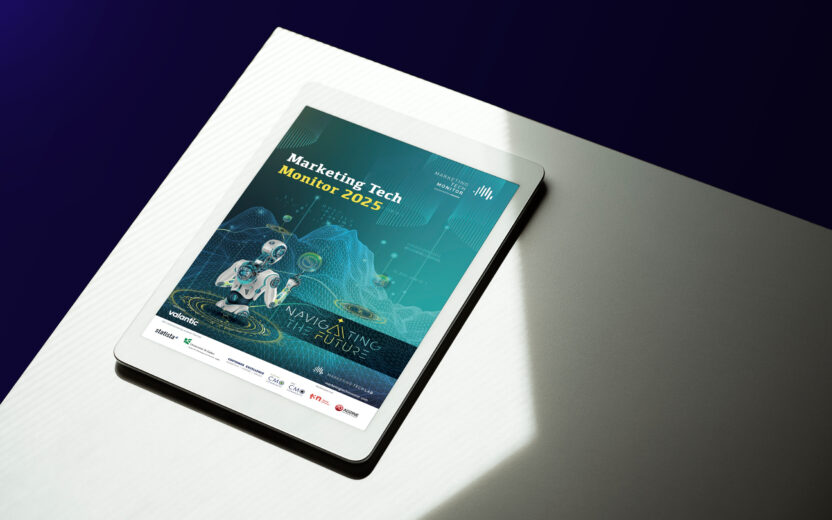
Marketing Tech Monitor 2025
AI-supported lead capture and qualification are, alongside automated email and follow-up campaigns, considered top application areas for AI agents. Discover more trends and potential for your data-driven business in the Marketing Tech Monitor.
What features and possibilities would you like to see from the AI Sales Agent in the future?
The exciting thing is that the AI can create a briefing from the information, which is constantly updated whenever we trigger new AI research or new information is added to the system. Here, too, we want to put the (potential) customer at the center and position ourselves to enrich their buyer journey, rather than thinking in an egocentric sales cycle. This approach is also incredibly helpful for account management:
Imagine a customer has been using CX services for years and now interacts with offerings from Digital Finance – showing interest in topics in that area. Then the responsible people from both service areas could automatically be notified and receive a briefing summarizing all previous touchpoints and interactions. This allows cross- and up-selling opportunities to be identified more quickly, while the customer receives value-added information at the right time and from the relevant points of contact for them. Naturally, this would also be highly interesting for upcoming pitches. The possibilities are manifold – and so is the business potential. The existing use cases with the AI Agent already show that we can look forward to exciting developments.

Christopher Kinnel
Head of Market Engagement
As Head of Market Engagement, Christopher is responsible for a large part of the new business funnel for CEC Germany: from lead generation and qualification to conversion into sales accepted leads. In his professional path, he has always operated in the B2B cosmos - both strategically and operationally, always at the interface between marketing and sales.
Get all the information on implementing the AI Sales Agent in our presentation – or leave us a message!
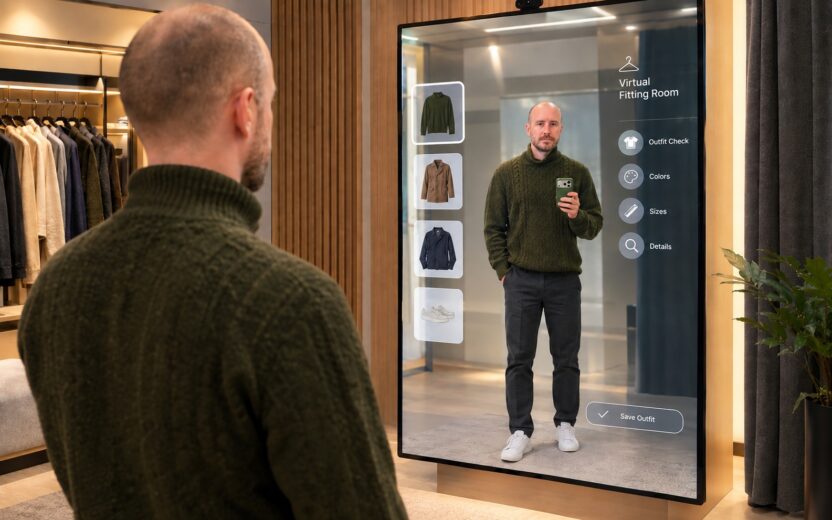

Customer Experience September 18, 2026
From webshop to virtual try-on: how AI is making its way into retail stores
Digital interfaces such as smart mirrors turn AI in the store into a tangible business case. What potential does this hold for the customer experience and in-store personalization? Matthias Vollmer explains how the retail industry can combine the best of both worlds and turn physical touchpoints into an intelligent part of the omnichannel journey.
From webshop to virtual try-on: how AI is making its way into retail stores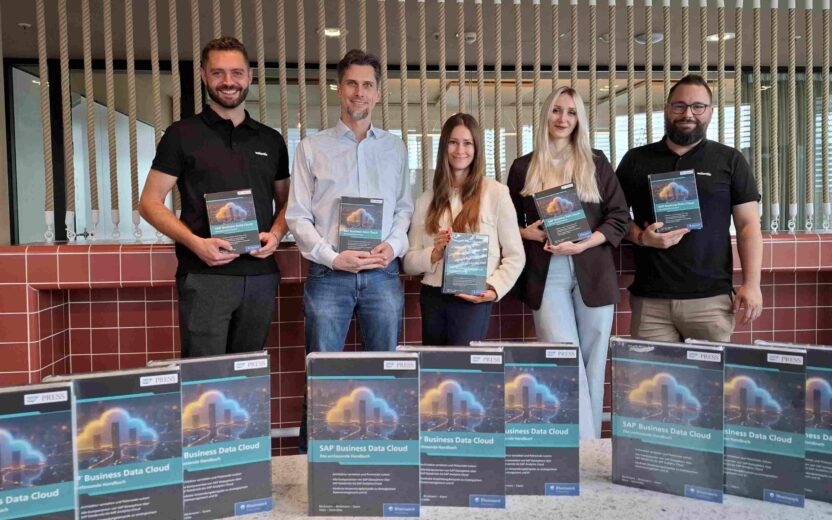
SAP Services September 17, 2026
The SAP BDC handbook: An interview on Business AI and data culture
Five valantic consultants wrote the SAP Business Data Cloud handbook. In this interview, they explain why SAP BDC is the enabler for business AI and why this book is a must-read.
The SAP BDC handbook: An interview on Business AI and data culture
Customer Experience August 27, 2026
Interview: How manufacturing stays digitally visible and AI-relevant
In the manufacturing sector, purchasing decisions are increasingly being made before the sales team is even involved. Designers, planners, maintenance technicians, and buyers conduct online research—and are increasingly receiving AI-generated responses. How can marketing teams at manufacturing companies ensure digital visibility and AI relevance? Answers and recommendations from the Manufacturing Practice.
Interview: How manufacturing stays digitally visible and AI-relevantDon't miss a thing.
Subscribe to our latest blog articles.